Why Irradiance Matters More Than LED Count
LED count is a marketing number. Irradiance and dose are what actually determine whether a red light session does anything at all.
Key Takeaways
- LED count is a manufacturing input, not a performance metric — it doesn't tell you how much light reaches your skin.
- Irradiance (mW/cm²) measures actual light power delivered at a given distance and is far more meaningful than diode count.
- Dose (J/cm²) = irradiance × time, and photobiomodulation research suggests effects are dose-dependent, not simply 'more is better.'
- Always ask at what distance an irradiance spec was measured — unspecified distances make the number unreliable.
- Watch for spec sheets that emphasize LED count while omitting irradiance, wavelength specificity, or measurement conditions.
Almost every red light therapy ad you'll see leads with LED count: "1,500 diodes!" "2,000 diodes!" It's an easy number to put in bold text, and it's also close to meaningless on its own. As a team that runs red light panels and beds daily and services them when components fail, we want to walk through the metric that actually determines whether a session is doing anything: irradiance.
The Number Everyone Advertises (and Why It's Misleading)
LED count tells you how many diodes are physically present in a panel. It says nothing about the quality of those diodes, how they're driven electrically, how they're arranged, or — critically — how much light energy actually reaches your skin. You can build a panel with twice as many LEDs as a competitor and deliver less usable light, if those diodes are lower output, poorly binned, or driven at reduced current to cut costs. LED count is a manufacturing input. It is not a performance output.
We understand why LED count became the go-to marketing number: it's simple, it's easy to compare at a glance, and bigger numbers feel like better value. But that simplicity is exactly the problem. A shopper comparing two panels side by side on LED count alone has no way of knowing which one actually delivers more usable light to their skin during a real session, and that's the only question that should matter when you're spending real money on a piece of equipment you plan to use regularly.
Irradiance: The Metric That Actually Matters
Irradiance is measured in milliwatts per square centimeter (mW/cm²) and describes the power of light actually landing on a given area of skin at a given distance. This is the number that determines whether a session is delivering a meaningful amount of light energy in a reasonable timeframe, or whether you'd need to sit in front of a panel for an hour to get a fraction of the exposure a well-engineered panel delivers in ten minutes.
Two panels can have identical LED counts and wildly different irradiance values depending on diode quality, driver electronics, lens/optics, and heat management (LEDs lose output efficiency as they heat up, so cooling design matters more than most buyers realize).
Dose: Irradiance Times Time
Irradiance alone still isn't the full picture — what ultimately matters for any physiological effect being studied is total dose, measured in joules per square centimeter (J/cm²). Two panels with very different irradiance ratings can, in principle, deliver an identical dose if session length is adjusted accordingly, which is why irradiance by itself doesn't tell the whole story either. Dose is calculated as:
Dose (J/cm²) = Irradiance (mW/cm²) × Time (seconds) ÷ 1000
This is why a low-irradiance panel and a high-irradiance panel can theoretically deliver the same dose — one just takes a lot longer to get there. Photobiomodulation research generally describes a biphasic, dose-dependent response, meaning there appears to be a range where a given dose may support the effect being studied, and doses far outside that range (too low or too high) may be less effective. This is an active area of research, and optimal dosing likely varies by application and individual, which is why we avoid promising specific outcomes for specific dose numbers.
Why Measurement Distance Changes Everything
Irradiance drops off sharply as you move away from a light source — this is basic physics (the inverse square law, roughly speaking, for point-source approximations). A panel that advertises "100 mW/cm²" is meaningless without knowing the distance that measurement was taken at. A number measured with a sensor pressed directly against the panel face will look dramatically better than the real-world irradiance a person experiences sitting or lying a foot or two away.
| What to Ask | Why It Matters |
|---|---|
| At what distance was irradiance measured? | Determines whether the advertised number reflects real-world use |
| Is irradiance reported for red, near-infrared, or combined wavelengths? | Different wavelengths can have different irradiance outputs from the same panel |
| Was the measurement taken with a calibrated spectrometer/radiometer? | Uncalibrated or unspecified measurement tools produce unreliable numbers |
Spec-Sheet Red Flags to Watch For
- No stated measurement distance. If a spec sheet lists irradiance without saying at what distance, treat the number with skepticism.
- LED count front and center, irradiance buried or absent. This is usually a sign the irradiance number isn't competitive.
- Vague wavelength ranges instead of specific peak wavelengths. "Red and near-infrared light" without specific nanometer values makes it hard to evaluate what's actually being delivered.
- No mention of how output is sustained over a session. Cheaper drivers can cause output to degrade as the panel heats up during use.
Wavelength Still Matters Alongside Irradiance
None of this is meant to suggest wavelength is unimportant — irradiance and wavelength work together, not in place of each other. Red wavelengths (roughly in the low 600s to mid 600s nm) and near-infrared wavelengths (roughly 800–900 nm range) are studied for different penetration depths and different applications, which is part of the rationale behind multi-wavelength panels and beds that combine several specific wavelengths rather than relying on a single one. A panel with excellent irradiance but only one wavelength gives you a narrower tool than a panel with strong irradiance across several studied wavelengths. When you're comparing products, look at both figures together: what wavelengths are included, and what is the measured irradiance for each, at a stated distance. A spec sheet that only gives you one of the two numbers is giving you half the picture.
What to Actually Ask a Manufacturer
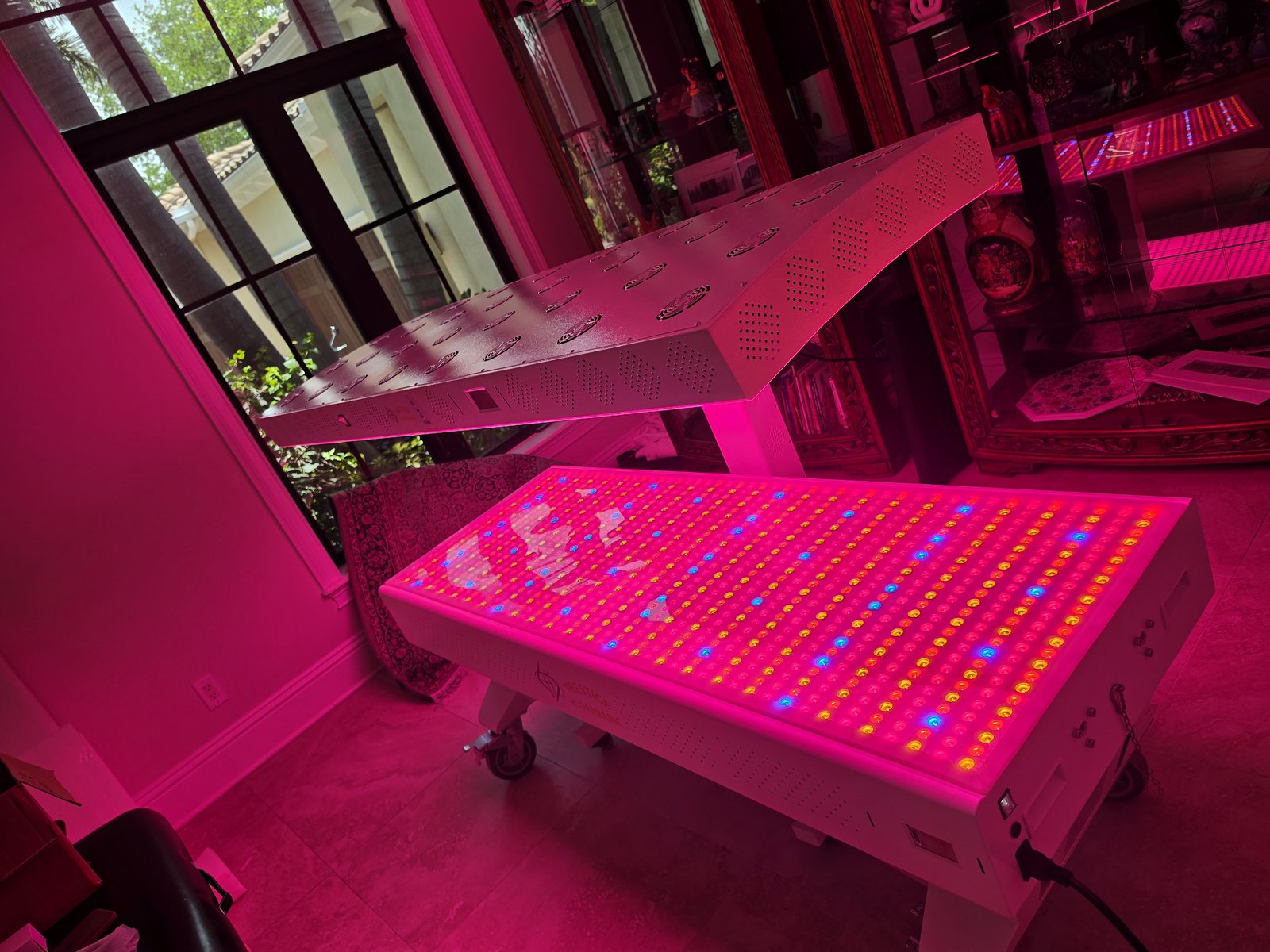
If you're evaluating a red light panel or bed — including our own Prestige Pro Modular 9-Wavelength Red Light Therapy Bed — the questions worth asking are: what is the irradiance at a specified, realistic distance (not just at the panel face), what specific wavelengths are included, and how is that irradiance measured and maintained across a session. Ask, too, whether output has been independently verified rather than only self-reported by the manufacturer, since third-party verification adds a layer of accountability that in-house numbers alone don't provide. A manufacturer that answers these clearly, with real numbers, real distances, and real wavelengths, is telling you more than any LED count ever will.
This is educational information, not medical advice. Red light therapy research is ongoing, and any specific health goal should be discussed with a qualified provider before starting a new protocol.
Frequently Asked Questions
Is a higher LED count always better for a red light panel?
Not necessarily. LED count doesn't tell you how much usable light energy actually reaches your skin. A panel with fewer, higher-quality, well-driven diodes can deliver higher irradiance than a panel with more but lower-output LEDs.
What's the difference between irradiance and dose?
Irradiance (mW/cm²) is the power of light hitting a surface at a given moment. Dose (J/cm²) is irradiance multiplied by exposure time, representing total light energy delivered over a session.
Why does measurement distance matter for irradiance specs?
Irradiance drops off significantly as distance from the light source increases. A number measured at the panel face will look much higher than what a person actually receives sitting or lying a foot or more away, so distance context is essential for comparing products fairly.
This article is educational information from equipment specialists, not medical advice. Hyperbaric oxygen therapy, red light therapy, sauna, cold plunge, and PEMF are not substitutes for care from a licensed clinician. Talk to your physician before starting any new protocol, especially if you are pregnant, have a cardiac or pulmonary condition, an implanted device, or are being managed for an active medical condition.