What is PEMF therapy? What it does, and what it doesn’t
PEMF is sold as everything from a bone-healing technology to a sleep aid. Some of that has a real regulatory and research history behind it. Some of it does not, and the two get blended constantly. Here is the line between them, with sources.
The short version
- PEMF stands for pulsed electromagnetic field. A coil carries a pulsing current, that changing field induces a small voltage in nearby tissue, and the pulsing is the point — a static fridge magnet does not do this.
- One narrow category of PEMF device has a deep FDA history: non-invasive bone growth stimulators, prescription devices used for fracture nonunions and failed spinal fusions.
- That category was reclassified from Class III to Class II on May 18, 2026. Before that date it was one of the rare device types that really was FDA approved rather than cleared.
- A consumer PEMF mat is not that device and is not covered by that history. Most are sold under FDA’s general wellness policy, which is a different regulatory position entirely.
- The honest summary of the evidence: strongest in supervised orthopedic bone-healing contexts, far more preliminary for general recovery, comfort and sleep.
What PEMF actually is
Run a pulsing electrical current through a coil and you get a magnetic field that rises and collapses with the pulse. Put tissue near that changing field and you induce a small electrical voltage inside it. That is Faraday induction, the same physics behind a transformer, applied at very low intensity.
Two things follow from that description. First, the pulse is not incidental — a constant field induces nothing, which is why PEMF and static magnet products are not the same category of thing regardless of how they are shelved together. Second, the variables that matter are frequency, waveform, intensity and how long the field is applied. A device that does not publish those numbers is asking you to take its word for it.
The FDA question, answered properly
This is where almost every page on the subject goes wrong, in both directions. Some say PEMF is FDA approved, full stop. Others say it is merely cleared and imply the whole field is unregulated. Neither is right, because the answer depends entirely on which device you mean.
Bone growth stimulators: the part with real regulatory weight
Non-invasive bone growth stimulators are the PEMF devices with the longest FDA history. They are prescription devices, indicated, in FDA’s own words, to “promote osteogenesis as an adjunct to primary treatments for fracture fixation and spinal fusion or as a treatment for established nonunions or failed fusions” (Federal Register, April 16, 2026).
For decades these were Class III devices requiring Premarket Approval, the strictest device pathway FDA has and the one that does involve a review of clinical safety and effectiveness data. The first such approval, PMA number P790002, covers the Bio-Osteogen System 204 (FDA premarket approval database, P790002). So the claim “PEMF is FDA approved” was, narrowly and specifically, true of this device type. That is genuinely unusual. It is the mirror image of hyperbaric chambers, which are cleared under 510(k) and have never been FDA approved — a distinction we cover in cleared versus approved, explained.
What changed in May 2026
FDA moved these devices down a class. In a final order issued on its own initiative, FDA reclassified non-invasive bone growth stimulators “from class III to class II (special controls),” with the order “effective May 18, 2026” (Federal Register, April 16, 2026). The reclassification is codified at 21 CFR 890.5870, covering product codes LOF and LPQ, and the device type “is not exempt from 510(k) requirements” — manufacturers now “may submit a premarket notification and obtain FDA clearance of the devices before marketing them.”
Practical translation. Devices approved before that date keep their approvals. New entrants go through 510(k) clearance instead of premarket approval. Going forward, the accurate phrasing for a new bone growth stimulator is cleared, not approved.
One thing worth knowing if you are checking this yourself: FDA’s product classification entry for code LOF still displayed Device Class 3 and submission type PMA when we checked (FDA product classification, LOF). Database pages lag rulemaking. The Federal Register order is the authority, and FDA had signalled the change in advance (FDA reclassification proposal). If a competitor’s page cites the classification database, that is probably why it is out of date.
The consumer mat is a different regulatory animal
Here is the part that matters most to anyone shopping. A full-body PEMF mat sold for home recovery is almost never a bone growth stimulator. It does not carry those indications, it was not reviewed under that pathway, and the bone-healing research history does not transfer to it.
Most consumer PEMF products are instead positioned under FDA’s general wellness policy, which covers low-risk products intended for “maintaining or encouraging a healthy lifestyle” and “unrelated to the diagnosis, cure, mitigation, prevention, or treatment of a disease or condition” (FDA general wellness guidance). The trade-off is strict: stay general-wellness and FDA largely leaves the product alone; make a disease claim and the same product becomes a regulated medical device that now needs a marketing authorization it does not have.
Which is why a mat’s own marketing tells you something. A seller making specific claims about diseases or conditions is not demonstrating confidence, it is describing a device that would need clearance it probably does not hold. FDA has made the parallel point about consumer stimulation devices generally: “Devices may only be marketed for uses that are established for the device or for uses that the firm can support with data” (FDA, electronic muscle stimulators).
The three kinds of PEMF system you will actually encounter
“PEMF device” covers hardware that does noticeably different jobs. The differences are about coil geometry and where the field is concentrated, and they decide which one is right for you more than any spec sheet number does.
Full-body mats
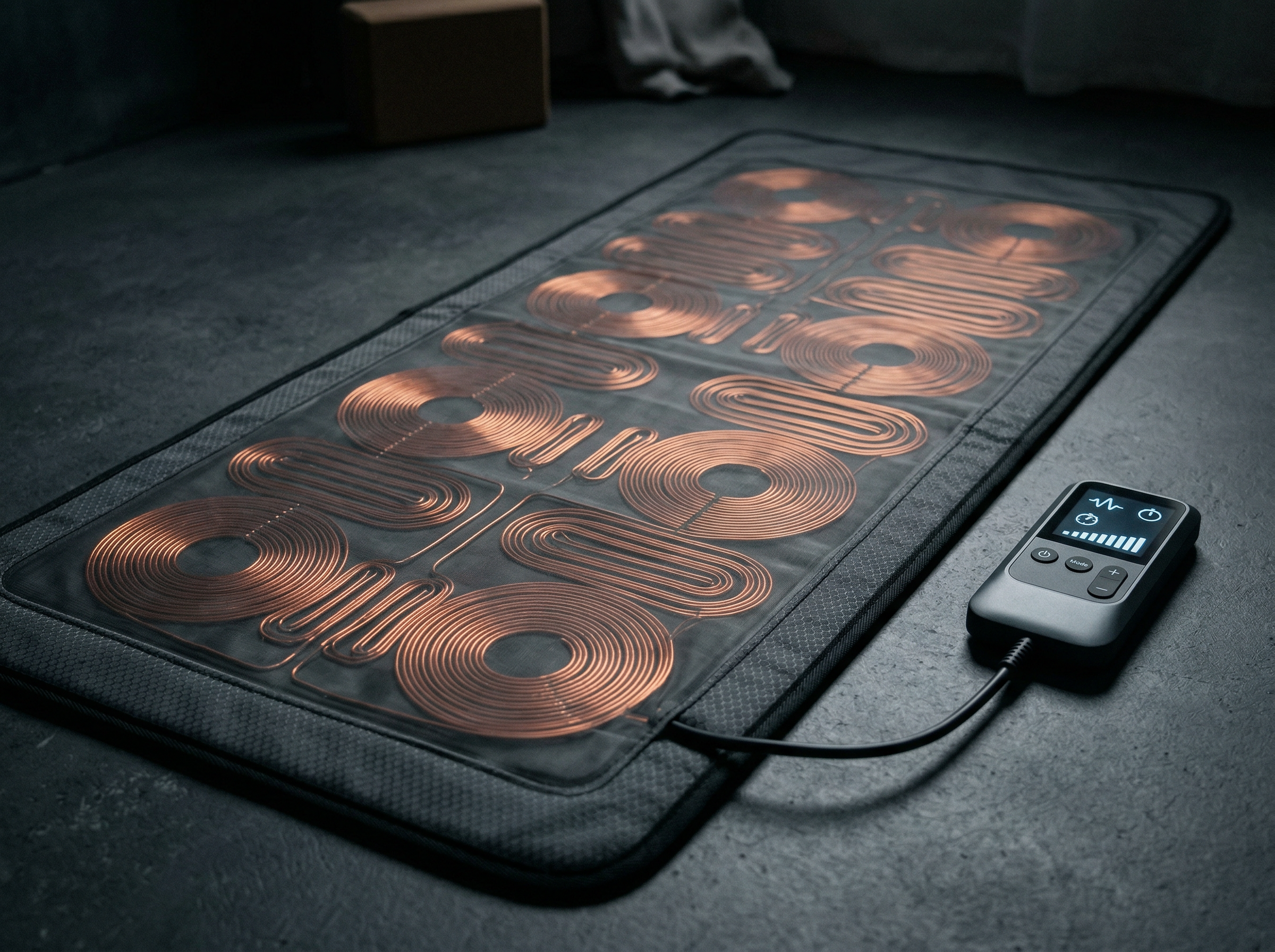
A flexible mat with coils distributed along its length, so you lie on it and the field covers most of the body at a relatively low intensity. This is the format most people mean by PEMF. The trade-off is coverage over concentration: broad, gentle, and easy to use unattended for a longer session. What varies between mats is the number of coils, how evenly they are spaced, and whether intensity is quoted at the coil surface or at the body.
Loop and ring applicators
A large-diameter loop you pass a limb or torso through, or position over one area. Because the field concentrates inside the loop, intensity at the target is higher than a mat delivers, and the session is attended and localised rather than whole-body. This is the format clinical systems use, usually with several interchangeable loop sizes plus smaller pads.
Local pads and paddles
Small applicators strapped to one spot. Highest concentration, smallest coverage. These are typically accessories to a loop system rather than a product bought alone.
The practical read: a mat is for routine whole-body use, loops and pads are for concentrating the field on one area. Neither is an upgrade of the other, and a facility running clients through sessions generally wants both.
How PEMF sits alongside other recovery inputs
PEMF is usually one item in a stack rather than a standalone. Because we run several of these in the same building, here is the honest comparison of what each one is and is not.
| Modality | What it applies | Session shape | Regulatory note |
|---|---|---|---|
| PEMF | Low-intensity pulsed magnetic field | 20–60 min, clothed, repeated over weeks | Prescription bone stimulators are Class II as of May 2026; consumer mats are general wellness |
| Hyperbaric oxygen | Increased ambient pressure with oxygen | 60–90 min, in a chamber, protocol-driven | Class II, cleared under 510(k), prescription device |
| Red and near-infrared light | Specific light wavelengths at the skin | 10–20 min, skin exposed | Varies by device and claim |
| Infrared sauna | Radiant heat | 20–45 min, heat-limited | Generally general wellness |
| Cold plunge | Cold water immersion | 2–10 min, cold-limited | Not a device claim |
They are not interchangeable and stacking them is not additive in any documented way. The reason they coexist is that they apply different physical inputs on different time scales, not that more inputs produce more result.
What the evidence supports, and where it thins out
The research picture is uneven, and the unevenness is the useful information.
Strongest. Supervised orthopedic bone healing. This is where the decades of study sit, where the prescription devices are indicated, and where a regulator has actually reviewed effectiveness data. It is also the context least like using a mat at home.
Genuinely preliminary. General recovery, comfort, sleep quality, everyday soreness. There is a real and growing literature here, but it is smaller, the trials are often short and small, protocols vary widely between studies, and blinding a device you can feel is hard. Preliminary is not the same as disproven, and it is not the same as established either.
Not supported by us. We do not make claims about PEMF for any disease or medical condition, and you should be sceptical of anyone selling equipment who does. See our PEMF evidence chapter for the detailed source-by-source treatment, including the mechanistic work and its limits.
A structural caution about protocol transfer: a study run at a specific frequency, waveform, intensity and duration tells you about that protocol. Consumer devices differ from research rigs on every one of those variables, so a cited study is often not evidence about the device it is being used to sell.
Safety and who should not use one
PEMF is low-intensity, and the safety questions are narrow but real. Talk to a physician before using any PEMF device if you have an implanted electronic device — a pacemaker, defibrillator, cochlear implant, or an implanted pump or stimulator. Electromagnetic fields can interfere with implanted electronics, and this is a clearance-from-your-doctor question rather than a read-the- manual question.
The same applies during pregnancy, with a seizure disorder, or with any active implanted metal hardware. Prestige Hyperbaric is a wellness center, not a medical facility, so this is a conversation for your own physician, not for us.
What to look for if you are buying one
- Published specifications. Frequency range, waveform, field intensity in gauss or tesla, and where in the device that intensity is measured. Intensity at the coil and intensity at your body are different numbers.
- Honest positioning. A seller who tells you what the device is not for is more credible than one who lists conditions.
- Coil coverage and construction. Whole-body mats vary in how many coils they use and how evenly they cover. Localised applicators do a different job than a full mat.
- Regulatory honesty. If a listing says a wellness mat is FDA approved, ask for the PMA or K number. If the answer is a bone growth stimulator’s paperwork, that paperwork is not for the mat.
- Support and warranty. Coils and control units fail. Ask who repairs it.
We stock both categories and they are genuinely different products: the Prestige Hyper-PEMF Mat for full-body use, and the clinical PMST LOOP systems with interchangeable applicators for targeted work. If you want to feel the difference rather than read about it, both run at our Holiday, Florida showroom.
Setting expectations honestly
PEMF is not a dramatic intervention. It is a low-intensity input that people generally use repeatedly over weeks, not once for an obvious effect. If a device promises something you would notice immediately and unmistakably, that promise is doing marketing work rather than describing physics.
The reasonable frame is that this is one input among several in a recovery routine, with a real research history in one specific clinical context and a thinner one everywhere else. That is a less exciting claim than most of the category makes. It is also the one we can source.
Cited research, not medical advice. Prestige Hyperbaric is a wellness center, not a medical facility, and does not diagnose, treat, cure, or prevent any disease or condition. Nothing here is legal or regulatory advice. Regulatory status changes — the reclassification described above took effect May 18, 2026, and FDA’s own classification database had not yet caught up when this was written.
Frequently Asked Questions
Is PEMF the same as using a static magnet?
No. PEMF devices generate a pulsing, time-varying electromagnetic field, while static magnet products produce a constant, unchanging field. The pulsing pattern is central to how PEMF is studied and differentiates it from simple magnet products.
What does the research actually support for PEMF?
PEMF has the strongest research history in specific clinical bone-healing contexts under medical supervision. Evidence for general recovery, comfort, or sleep-related home use is more preliminary and mixed, so claims in that area should be treated cautiously.
Can I use a PEMF mat with a pacemaker or other implanted device?
This should be discussed with a physician first. Electromagnetic field exposure may interact with pacemakers or other implanted electronic devices, so medical clearance is important before use.
This article is educational information from equipment specialists, not medical advice. Hyperbaric oxygen therapy, red light therapy, sauna, cold plunge, and PEMF are not substitutes for care from a licensed clinician. Talk to your physician before starting any new protocol, especially if you are pregnant, have a cardiac or pulmonary condition, an implanted device, or are being managed for an active medical condition.