Premium Oxygen Analyzer: Breathing Gas & Ambient Air Testing Explained
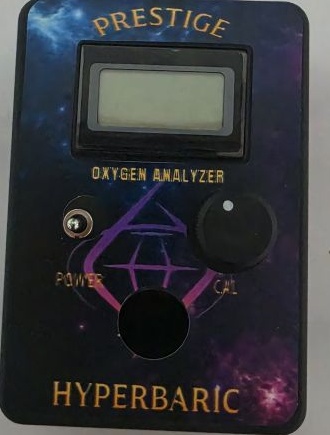
Confirming oxygen purity is one of the simplest ways to run a safer hyperbaric session — but "testing the oxygen" actually means two different things depending on what you're checking. Here's the difference between breathing-gas testing and ambient chamber-air testing, why they need different equipment, and how the Premium Oxygen Analyzer and Constant O2 Monitoring Kit work together to cover both.
In this article
Two different testing jobs
When operators ask about "testing the oxygen," they're usually asking about one of two very different things. The first is breathing-gas testing — confirming what's actually reaching the client through the mask or hood. The second is ambient chamber-air testing — confirming what's in the atmosphere of the cabin itself, independent of what any one client is breathing. Both matter. Neither substitutes for the other. And critically, they call for different hardware setups on the same analyzer, or in the case of continuous chamber monitoring, an additional piece of equipment entirely.
Testing breathing gas at the mask
This is the more familiar use case: connecting the analyzer's sample line directly to the gas delivered at the mask or hood to confirm oxygen concentration before or during a session. It's a direct, point-in-time reading of exactly what the client is inhaling. The Premium Oxygen Analyzer's mask/hose configuration is built for this — fast response, accurate at the delivery point, and simple to run as a pre-session check.
Testing ambient air inside the chamber
This is a different question: what's the oxygen level of the air filling the chamber itself, not just what's flowing to the mask? This matters most for facilities running oxygen-enriched environments or needing to confirm the cabin atmosphere stays under a safety threshold throughout a session — not just at the start. The catch is that you cannot simply place a standard oxygen sensor inside a pressurized chamber and expect an accurate reading.
Why one sensor can't do both at the same time
Pressure changes oxygen's partial pressure. A sensor sitting inside a pressurized cabin reads a distorted value — it's responding to pressure changes as much as to actual oxygen concentration, which makes it unreliable for continuous ambient monitoring. That's the reason the Premium Oxygen Analyzer should never be used inside a pressurized chamber. It's built for ambient-pressure measurement, full stop.
The solution is the Constant O2 Monitoring Kit. It installs outside the chamber and creates a small, precisely metered sampling line that continuously draws air from inside the cabin and delivers it to the external analyzer, which reads it at normal ambient pressure. Sampling only begins once the chamber passes 1.2 ATA — so it never interferes with door-seal engagement — and it's built for continuous use at 1.3 ATA and above. The result: an accurate, trustworthy ambient oxygen reading, updated continuously, without ever putting the sensor itself inside the pressurized space.
Calibrating the analyzer correctly
Before any session, power the analyzer on and let it calibrate to 20.9% in normal room air — that's the baseline for atmospheric oxygen. As a quick functional check, gently blow across the sensor; the reading should dip to roughly 16 to 18 percent and then slowly climb back toward 20.9% as the sensor re-equilibrates. Don't force air into the sensor or use it as a pressurized-line test — it's a gentle functional check, not a stress test.
Building a complete testing setup
For most facilities, the right answer isn't "pick one" — it's both. Use the mask/hose configuration to verify breathing-gas purity before each session, and pair the analyzer with the Constant O2 Monitoring Kit for continuous ambient-air visibility throughout. Together, that's full coverage: what the client breathes, and what fills the chamber.
The Premium Oxygen Analyzer ships in a protective hard case with a complete printed instruction manual — safety, calibration, setup, and care — for $500 plus $25 shipping. The Constant O2 Monitoring Kit is available as a standalone sampling kit at $500 plus $30 shipping, or as a combo bundle with the analyzer for $950 plus $30 shipping. Chamber port configurations vary, so we ask every customer to confirm compatibility with us before ordering — professional installation is available if you'd rather have it done for you.
Ready to cover both testing jobs?
Order the analyzer alone, add the Constant O2 Monitoring Kit for continuous chamber-air visibility, or get the combo bundle in one order.
Shop Oxygen Analyzer — $500 Shop Constant O2 Kit — From $500FAQ
- What is the difference between breathing-gas and ambient chamber-air oxygen testing?
- Breathing-gas testing checks the oxygen concentration actually being delivered to the mask or hood the client breathes from. Ambient chamber-air testing checks the oxygen level of the air inside the cabin itself. These are two separate readings that answer two separate safety questions, and the Premium Oxygen Analyzer supports both configurations — but not at the same time, and not with the same hose setup.
- Can I use the Premium Oxygen Analyzer directly inside a pressurized chamber?
- No. The analyzer is built for ambient-pressure measurement and should not be placed inside a pressurized chamber, because pressure changes oxygen's partial pressure and will distort the reading. To monitor chamber air continuously during a session, pair the analyzer with the Constant O2 Monitoring Kit, which routes a sample of chamber air outside to the analyzer at ambient pressure.
- How do I calibrate the Premium Oxygen Analyzer?
- Power the analyzer on and let it calibrate to 20.9% in normal room air. As a functional check, gently blow across the sensor — the reading should dip to roughly 16 to 18 percent and then slowly recover back toward 20.9%. Do not force air into the sensor or use it as a pressurized-line test.
- Does the Constant O2 Monitoring Kit fit any hyperbaric chamber?
- It is designed as a universal fit for both soft-shell and hard-shell chambers, but port configurations and fittings vary by chamber model. Confirm compatibility with Prestige Hyperbaric before ordering, and ask about professional installation if you'd rather not do it yourself.
This article is provided for general informational purposes about equipment use and does not replace facility-specific safety protocols, manufacturer instructions, or applicable regulatory requirements (including NFPA 99 where relevant). Ambient oxygen monitoring supports safe operation but does not by itself constitute regulatory compliance. Contact Prestige Hyperbaric to confirm compatibility and requirements for your specific chamber and facility.